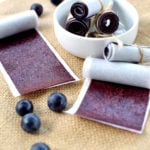
Raw Grape Fruit Leather
This is a tasty way to preserve grapes. It is completely raw which means it has all the original enzymes and much of the nutrition. The color of this fruit leather stays vibrant and dehydration intensifies the original flavor. It is by far the most flavorful fruit leather I make. |Makes about 10 strips of fruit leather|
Servings: 10 strips of fruit leather
Equipment
- Blender (optional)
Ingredients
- 4 lbs Sungold or Concord Grapes Stems Removed and Rinsed
- 2 Tablespoons Honey Optional
Instructions
- Press all the grapes through a food mill or sauce maker. (Use the proper attachments for crushing grapes, my food mill uses a special grape spiral)
- After you run it through the food mill once, take all the skins and left over pulp and push them through the food mill one more time. It will be a little more difficult to get it all through but will extract quite a bit more juice and pulp.
- Discard the grape skins and seeds into the compost. And save the juice/pulp that came out of the food mill. I had about 5 + 1/4 cups liquid when I was finished.
- Now you need to separate the juice and pulp. Grab a metal food sieve and place over a large bowl.
- Pour the liquid through it. The pulp should stay in the food sieve, while the majority of the juice will drain out the bottom. You should have about 3 cups of pulp remaining.
- The juice is a natural by product of making this recipe and is not used for the fruit leather. Its really delicious. If you don’t want to consume it right away, store in the refrigerator for up to 4 days.
- Next you have a few options. You can skip right to step 8 and place on trays, or you can blend the pulp in a blender for a smoother more uniform finished product. I tested both methods and they both worked.
- Take the remaining 3 cups of pulp and spread it on dehydrator trays with mats. The perfect thickness to start with when spreading the pulp is 1/4 inch deep. No more, no less. I actually get out a ruler and measure! It may still be a little juicy and difficult to maintain that thickness at the edge. Just do your best. If using an excalibur dehydrator it will make 2 and a half trays.
- Dehydrate in a dehydrator at 105ºF for about 12 hours. It should feel dry when finished but maintain it’s flexibility.
- Let cool completely and then peel it off the mat. It will be a little difficult to get started if your edges were thinner but it should all come off in one piece.
- Place the fruit leather onto parchment paper and cut both the fruit leather and parchment paper into 2 inch wide strips.
- Roll up fruit leather and tie with string. Store in a cool, dark place.
Notes
If you find your pulp you pour on the trays too juicy and difficult to work with, pour it though the food sieve again to separate out more of the juice.
Canning the leftover juice is a great option. If canning the juice, you may want to triple or quadruple this recipe so you have enough juice to make it worth the effort of canning.
Because this fruit leather is raw and has all the enzymes, it doesn’t have as long as a storage life as a cooked fruit leather. Storage time is unknown to me… my family eats all the fruit leather so fast ours never goes bad! I’ve had it last for a month in perfect condition but that’s all I can tell you haha!
